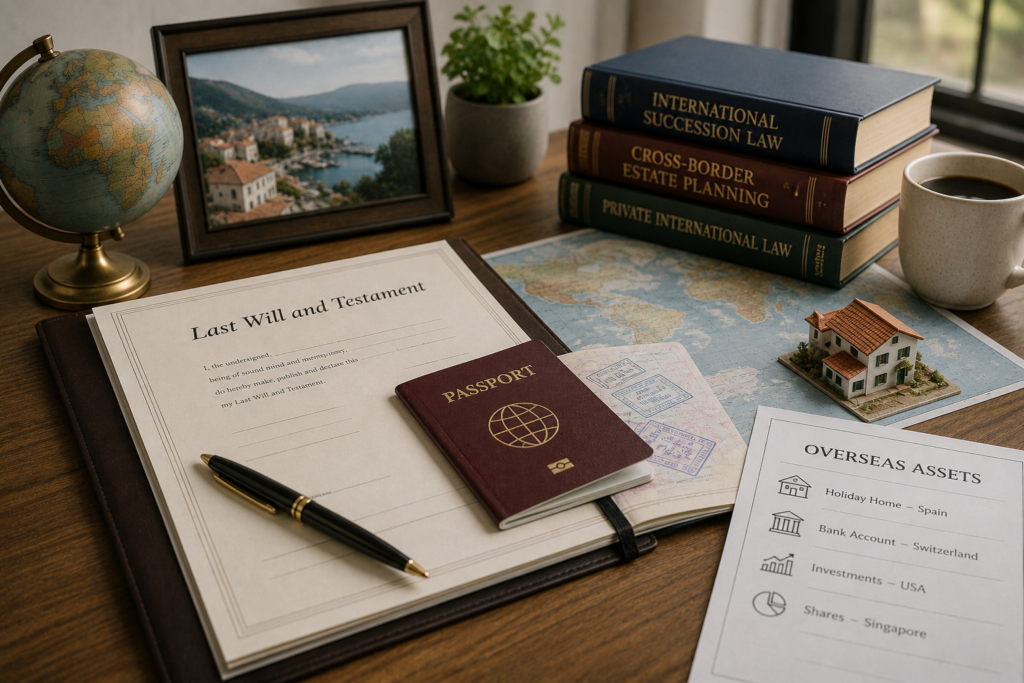
How to Handle Foreign Assets in a UK Will
Owning assets outside the UK can make estate planning significantly more complicated.
A person living in England might own a holiday home in Spain, an apartment inherited from family overseas, money in a foreign bank account, shares in an overseas company or investments held through an international financial institution.
They may naturally assume that a UK will is enough to determine what happens to all of those assets after death.
Sometimes a UK will can cover overseas assets. However, that does not necessarily mean the administration of those assets will be straightforward or that English law alone will determine what happens.
Different countries have different succession laws, probate procedures, property rules and tax systems. Some jurisdictions also restrict how certain assets can be inherited.
As a result, people with international assets should approach their wills differently from those whose entire estate is located in England and Wales.
Careful planning can help reduce the risk of conflicting wills, unexpected tax consequences, delays and disputes between beneficiaries.
This article explains some of the key issues to consider when dealing with foreign assets in a UK will.
What Counts as a Foreign Asset?
A foreign asset is broadly an asset situated or held outside the UK.
This can include obvious examples such as a holiday home abroad, but international estates can contain many different types of property.
Examples may include:
- Houses, apartments and land overseas;
- Foreign bank accounts;
- Overseas investment accounts;
- Shares in foreign companies;
- Interests in overseas businesses;
- Foreign pensions;
- Valuable possessions kept abroad;
- Certain international insurance arrangements; and
- Other financial or property interests situated outside the UK.
Even a relatively modest foreign asset can create additional administrative requirements after death.
Can a UK Will Cover Assets Abroad?
Potentially, yes.
A will made in England and Wales can be drafted with the intention of covering assets outside the UK.
However, whether and how the will is recognised in another country depends on the law and procedures of that jurisdiction.
That distinction is important.
A will may state that it applies to a property abroad, but the authorities in the country where that property is located may still require local procedures before ownership can be transferred.
Local succession rules may also affect the result.
For this reason, somebody with significant foreign assets should not assume that simply mentioning them in an English will solves every issue.
Why Does the Location of an Asset Matter?
Different assets can be subject to different legal rules.
Real estate is particularly important because the law of the country where land or property is located can have a major role in determining how it is dealt with following death.
Other types of property may involve different conflict-of-laws principles.
Questions can also arise about the deceased person’s domicile, long-term residence or other connecting factors.
International succession can therefore involve more than one legal system at the same time.
That is why advice may be required both in England and Wales and in the country where the foreign asset is situated.
A Common Example: Owning a Holiday Home Abroad
Imagine a couple living permanently in England.
They own their main home in England but also purchased an apartment abroad several years ago.
Their English wills leave their estates to each other and then to their children.
They might reasonably assume that the English wills automatically allow their executors to transfer the foreign apartment in exactly the same way as their English property.
In practice, the executors may have to deal with local authorities, foreign legal procedures, translations, property-registration requirements and possibly a local probate or succession process.
Local tax may also need to be considered.
The existence of the English will is therefore only one part of the overall picture.
Do All Countries Follow English Succession Law?
No.
Succession laws differ considerably around the world.
England and Wales generally provide substantial freedom for a person to decide through a will who should inherit their estate, although claims against estates can arise in certain circumstances.
Other countries may have forced heirship rules.
These can reserve specified portions of an estate for particular relatives, such as children or spouses.
Consequently, a provision that appears straightforward under English law may potentially interact with mandatory rules in another jurisdiction.
Local advice is essential where the relevant country has forced-heirship or other compulsory succession rules.
What Is Forced Heirship?
Forced heirship refers broadly to laws that restrict a person’s freedom to leave their estate entirely as they wish.
Under such systems, certain relatives may have legally protected inheritance rights.
The details differ significantly between jurisdictions.
For example, one country may reserve part of an estate for children, while another may apply different rights to spouses or other family members.
Whether those rules affect a UK resident’s foreign assets can depend on several factors, including the type and location of the asset and the relevant country’s private international law.
It should therefore never be assumed that the English concept of testamentary freedom will automatically apply worldwide.
Should You Have One Will or Separate Wills?
There is no universal answer.
Some people use a single English will intended to cover their worldwide estate.
Others have an English will dealing with UK assets and a separate foreign will dealing with assets in another country.
Either approach can potentially be appropriate depending on the circumstances.
The important issue is coordination.
Multiple wills must be drafted carefully so that one does not accidentally revoke another.
The Danger of Accidentally Revoking Another Will
Wills commonly contain revocation clauses cancelling earlier testamentary documents.
That is usually helpful where somebody is replacing an old will with a new one.
It can become dangerous where somebody intentionally has separate wills in different countries.
Suppose a person makes an English will covering their UK estate.
Later, they visit a lawyer abroad and make a local will concerning a foreign property.
If the foreign document contains a broad clause revoking all previous wills, it could potentially create problems for the English arrangements.
The reverse can also happen.
An English will prepared later could unintentionally interfere with a foreign will.
Where multiple wills are used, the advisers in each jurisdiction should know that the other documents exist.
Why Coordinated Legal Advice Matters
International estate planning often requires advisers from different jurisdictions to work together.
An English solicitor can advise on the English will and relevant law in England and Wales.
A lawyer qualified in the foreign country can explain local succession, probate, property and tax requirements.
The objective is to make sure the different arrangements complement rather than contradict each other.
This can be particularly important where:
- Valuable overseas property is involved;
- The foreign country has forced-heirship rules;
- There are multiple nationalities or residences involved;
- The person owns businesses abroad;
- There are beneficiaries living in different countries; or
- Significant tax liabilities could arise.
Does Brexit Affect European Assets?
For people with property in EU countries, European succession rules may also need consideration.
The EU Succession Regulation, sometimes referred to as Brussels IV, applies in participating EU Member States.
The UK did not participate in the Regulation.
Nevertheless, the Regulation can still be relevant to a British person who owns assets in a participating EU country.
In appropriate circumstances, the Regulation allows a person to choose the law of their nationality to govern their succession.
Whether such an election is appropriate and how it affects a particular estate should be considered with advisers familiar with the relevant country.
This is an area where specialist cross-border advice can be particularly valuable.
Can Choosing English Law Avoid Forced Heirship?
Potentially in some European situations, but this should not be treated as a universal solution.
Where the EU Succession Regulation applies, a choice of the law of nationality can sometimes affect which succession law governs an estate.
For a British national, this may allow an election for the law associated with their nationality, subject to the relevant rules.
However, international succession is complex.
Tax rules, property registration and other mandatory laws can still apply separately.
The effectiveness and desirability of a choice-of-law clause should therefore be confirmed with advisers in the relevant jurisdiction.
What Information Should You Give Your Solicitor?
When making a will, tell your solicitor about all significant overseas assets.
Useful information may include:
- The country where the asset is located;
- The nature of the asset;
- How it is legally owned;
- Its approximate value;
- When and how it was acquired;
- Whether it is jointly owned;
- Whether there is an existing foreign will;
- Whether local legal advice has already been obtained; and
- Any foreign tax or succession planning already in place.
Do not assume an overseas asset is irrelevant simply because it represents a relatively small proportion of your overall wealth.
Its location may create separate legal requirements.
Foreign Property Ownership Matters
How a foreign property is owned can affect what happens on death.
Some countries have forms of joint ownership that operate differently from those used in England and Wales.
Property registration documents should therefore be reviewed rather than relying on assumptions about ownership.
If a property is jointly owned with a spouse, relative or business partner, local law may determine whether the deceased’s interest passes automatically, forms part of the estate or is dealt with in another way.
A local lawyer can explain the effect of the title.
What About Foreign Bank Accounts?
Foreign bank accounts should also be considered during estate planning.
After death, the bank may require documents before releasing funds.
These requirements can differ between countries and institutions.
Executors might need to provide:
- A death certificate;
- A grant of probate or equivalent document;
- Certified copies;
- Translations;
- Evidence of identity;
- Local tax documents; or
- Other legal documentation.
Even where the account balance is not particularly large, the administrative process can take time.
Keeping accurate records of foreign accounts can therefore help executors.
What About Overseas Investments?
International investments can raise similar issues.
The legal location of an investment may not always be obvious from the investor’s physical location.
Shares may be issued by a foreign company, investments may be held through overseas institutions, and financial products may be subject to foreign administration requirements.
Business interests can be even more complicated because shareholder agreements, company constitutions and local corporate law may affect what happens following death.
Professional advice should be obtained where significant overseas investments or businesses are involved.
Can Foreign Assets Be Subject to UK Inheritance Tax?
Potentially.
UK Inheritance Tax treatment depends on the applicable rules and the person’s circumstances.
From 6 April 2025, major changes were introduced to the UK’s Inheritance Tax treatment of overseas assets.
The previous domicile-based framework was replaced for relevant purposes by a residence-based system.
A person’s status as a long-term UK resident can therefore be particularly important in determining whether foreign assets fall within the scope of UK Inheritance Tax.
This is an area where older online articles may now be outdated.
What Is a Long-Term UK Resident for Inheritance Tax?
Under the post-April 2025 regime, whether non-UK assets fall within the UK Inheritance Tax framework can depend on the individual’s residence history.
Broadly, an individual may become a long-term UK resident for these purposes after being UK resident for at least 10 out of the previous 20 tax years.
The detailed rules should be considered carefully because the treatment can also continue for a period after somebody leaves the UK, depending on their residence history.
People with substantial overseas assets should therefore obtain current tax advice rather than relying on the former domicile-based rules.
What If You Have Recently Moved to the UK?
People moving to the UK with existing foreign wealth should review their estate planning.
They may have:
- A will from their previous country;
- Property abroad;
- Foreign bank accounts;
- Family members overseas;
- Trust arrangements; or
- Existing succession planning based on another country’s law.
UK residence can have important tax consequences over time.
Existing wills may also need to be coordinated with new arrangements in England and Wales.
An international estate-planning review can help identify potential conflicts before they become problems.
What If You Leave the UK?
Moving abroad does not automatically make previous estate planning irrelevant.
A person may retain UK assets while becoming resident elsewhere.
The new country may also apply its own succession and tax rules.
Under the current UK Inheritance Tax system, exposure concerning overseas assets can potentially continue for a period after departure where the individual has previously been a long-term UK resident.
The duration depends on the relevant statutory rules and residence history.
Anyone planning a permanent international move should therefore review their will and tax position before or around the time of relocation.
Can the Same Asset Be Taxed in Two Countries?
Potentially, yes.
Cross-border estates can create situations in which more than one jurisdiction asserts taxing rights.
The UK has arrangements with some countries designed to address double taxation on estates or inheritances.
In other cases, unilateral relief may potentially be available under UK rules.
The exact outcome depends on the countries involved, the type of asset and the applicable taxes.
Tax treaties should never simply be assumed to exist.
Professional advice should be obtained for the specific jurisdictions involved.
What Is Double Taxation Relief?
Double taxation relief is designed to reduce the risk of the same property being subjected to overlapping death-related taxation in more than one jurisdiction without appropriate credit.
The UK has estate-tax treaties with certain countries.
Where no treaty applies, UK law can provide unilateral relief in some circumstances.
However, foreign taxes do not always correspond neatly with UK Inheritance Tax.
One country may impose estate tax, another inheritance tax, and another may impose taxes connected with transferring or registering property.
International tax advice can therefore be important even where the estate itself appears relatively straightforward.
Should Executors Know About Foreign Assets?
Yes.
Executors need enough information to identify and administer the estate.
If overseas assets exist but nobody knows about them, administration can become much more difficult.
The will itself does not necessarily need to contain account numbers, passwords or every detailed financial record.
Instead, the person can maintain a secure and up-to-date record showing where important assets and documents can be found.
Executors should know how to locate that information when needed.
Should You Put Account Details in Your Will?
Generally, a will is not the ideal place for sensitive information such as passwords and detailed banking credentials.
After probate is granted, a will generally becomes a public document.
Account details can also change frequently, meaning that including them directly in a will can quickly make the document outdated.
A separate secure asset record is often more practical.
It can be updated without having to execute a new will each time an account changes.
Foreign Language Documents
Foreign estates may involve documents written in another language.
Executors may need translations of:
- Wills;
- Property documents;
- Death certificates;
- Probate documents;
- Company records; or
- Other legal documents.
The relevant authority may require a certified or officially recognised translation.
This can increase both the time and cost involved in administering the estate.
Keeping original foreign documents organised can make the process easier.
Foreign Executors and Beneficiaries
International families often have executors or beneficiaries living in different countries.
This is possible, but it can create practical complications.
Identity verification, signatures, banking arrangements, tax reporting and communication may become more complicated across borders.
Some foreign jurisdictions may also have specific rules concerning who can administer local assets.
The practical suitability of proposed executors should therefore be considered alongside personal trust.
What If Your Beneficiary Lives Abroad?
Leaving assets to somebody living abroad can potentially create tax, reporting or practical consequences for the beneficiary in their country of residence.
The UK tax position is only part of the picture.
The beneficiary’s country may impose inheritance, gift, income or other taxes.
This does not mean overseas beneficiaries should be excluded.
It simply means that significant international gifts may benefit from coordinated advice.
What About Foreign Pensions?
Foreign pensions can operate differently from ordinary estate assets.
The scheme rules may determine what happens after death.
Beneficiary nominations or local pension legislation may also be relevant.
A will should therefore not be assumed to override the rules of every overseas pension arrangement.
The pension provider’s terms and the law governing the scheme should be reviewed separately.
International Business Interests
Owning a foreign company or an interest in an overseas business adds another layer of complexity.
Questions may arise concerning:
- Transfer of shares;
- Local corporate law;
- Shareholder agreements;
- Business succession;
- Valuation;
- Taxation; and
- Who can exercise control following death.
The English will, foreign company documents and any local succession planning need to work together.
Business owners with international interests should generally seek specialist advice rather than treating foreign shares like an ordinary bank account.
What If You Already Have a Foreign Will?
Tell your English solicitor before making another will.
The solicitor needs to understand what the foreign document covers and whether the new English will could affect it.
Where appropriate, a copy can be reviewed with foreign counsel.
The objective is to determine:
- Which assets each will covers;
- Whether the documents conflict;
- Whether either document contains problematic revocation wording; and
- Whether the combined arrangement remains effective.
Do not destroy or replace a foreign will without first understanding its legal effect.
What If You Buy Foreign Property After Making Your Will?
Review your estate planning.
A will may have been drafted broadly enough to cover subsequently acquired property, but the new foreign asset may create local legal or tax issues that were never considered when the will was prepared.
Buying a substantial asset abroad is therefore a sensible trigger for a will review.
The same applies when selling the last foreign asset covered by a separate overseas will.
Estate planning should reflect the assets that actually exist.
What If You Sell the Foreign Asset?
If a will makes a specific gift of a particular property and that property is sold before death, the gift may no longer operate in the way originally intended.
The sale proceeds do not necessarily substitute automatically for the property in every situation.
This is one reason wills should be reviewed following major asset changes.
A solicitor can advise whether the existing provisions still achieve the intended result.
Should You Make a Will in Every Country Where You Own Assets?
Not necessarily.
Multiple wills can sometimes simplify local administration, but they can also increase the risk of inconsistency.
The correct strategy depends on the countries and assets involved.
For someone with one modest overseas bank account, a separate foreign will might be unnecessary.
For somebody with valuable real estate and a business in another jurisdiction, separate coordinated wills may be worth considering.
The decision should follow legal advice rather than a general rule.
Why DIY International Wills Can Be Risky
International estate planning is one of the areas where a generic online will template can be particularly risky.
A template may not identify:
- Forced-heirship rules;
- Foreign tax exposure;
- Conflicts between wills;
- Property ownership issues;
- International succession regulations;
- Business-transfer restrictions; or
- The effect of residence and nationality.
GOV.UK specifically identifies owning property overseas as a circumstance in which professional advice should be considered when making a will.
The complexity lies not only in drafting the English document but in understanding how it interacts with foreign law.
Keeping Your International Estate Plan Updated
Cross-border circumstances can change frequently.
A review may be appropriate following:
- Buying or selling foreign property;
- Moving to another country;
- Returning to the UK;
- Acquiring another nationality;
- Marriage or divorce;
- Changes in foreign succession law;
- Changes in UK tax law;
- Opening or closing significant overseas accounts;
- Acquiring a foreign business; or
- Changes in intended beneficiaries.
Regular reviews can help prevent an estate plan from becoming disconnected from the person’s actual circumstances.
Questions to Ask When You Own Foreign Assets
When reviewing a will, consider:
- Which countries contain my assets?
- What type of assets do I own there?
- How are foreign properties legally held?
- Do I already have wills in other countries?
- Could one will revoke another?
- Do forced-heirship rules apply?
- Is the EU Succession Regulation relevant?
- Could my overseas assets fall within UK Inheritance Tax?
- Could foreign death or inheritance taxes also apply?
- Is double-taxation relief available?
- Do my executors know where my foreign documents are?
- Are my English and foreign advisers coordinating their advice?
Answering these questions can reveal where specialist advice is needed.
Conclusion
Foreign assets can transform an otherwise straightforward will into a cross-border estate-planning exercise.
An English will can potentially cover assets outside the UK, but that does not mean English law or English probate procedures will automatically determine what happens to every foreign asset.
The country where an asset is located may have its own succession rules, probate requirements, property laws and taxes.
Some countries also operate forced-heirship regimes that can restrict testamentary freedom.
Where multiple wills are used, careful coordination is essential. A new will prepared in one country should not inadvertently revoke a valid will dealing with assets elsewhere.
Tax planning also deserves particular attention.
Since 6 April 2025, the UK’s Inheritance Tax treatment of overseas assets has moved from the previous domicile-based framework towards a residence-based system. Long-term UK residence can therefore have significant implications for international estates.
The most effective approach is usually to look at the estate globally rather than treating each asset in isolation.
That means identifying where assets are located, understanding how they are legally owned, considering which country’s succession rules may apply and ensuring that advisers in relevant jurisdictions coordinate their work.
For people with overseas property, investments, businesses or substantial financial accounts, specialist advice can help create a will structure that works not only on paper in England and Wales but also in the countries where the assets actually need to be administered.
How to Handle Foreign Assets in a UK Will Read More »