Author name: Nadeem Afzal

Health vs Financial LPA: What’s the Difference?

Understanding Lasting Power of Attorney (LPA)

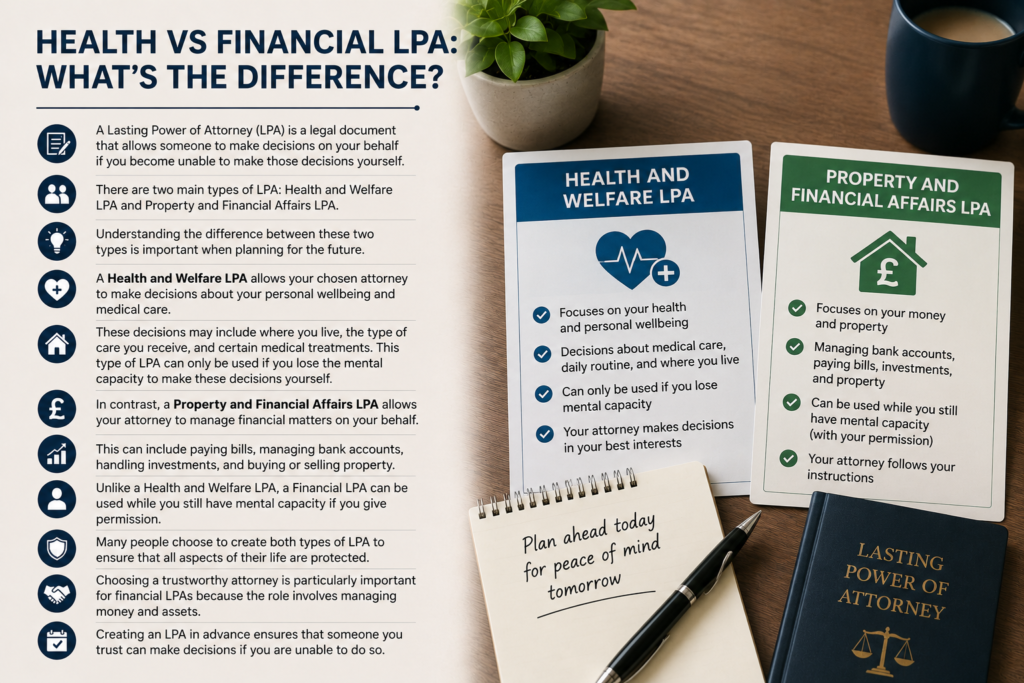
A Lasting power of attorney (LPA) is a legal document that enables a trusted person to make decisions on your behalf if you become unable to make those decisions yourself in the future.

There are two types of LPA, each covering different areas of your life:

  • Health and Welfare LPA
  • Property and Financial Affairs LPA

Understanding the purpose of each can help you make informed decisions when planning for the future.


Health and Welfare LPA

A Health and Welfare Lasting Power of Attorney allows your chosen attorney to make decisions about your personal wellbeing if you lose the mental capacity to do so yourself.

These decisions may include:

  • Medical treatment and healthcare choices
  • Daily care and support arrangements
  • Where you live and receive care
  • Decisions relating to personal welfare

This type of LPA only becomes effective when you are no longer able to make these decisions independently.


Property and Financial Affairs LPA

A Property and Financial Affairs Lasting Power of Attorney allows your attorney to manage your financial matters and assets on your behalf.

Responsibilities may include:

  • Managing bank and savings accounts
  • Paying bills and household expenses
  • Handling investments and pensions
  • Buying, selling, or managing property

Unlike a Health and Welfare LPA, this type of LPA can be used while you still have mental capacity, provided you have given your attorney permission to act.


Should You Have Both Types of LPA?

Many people choose to create both types of Lasting Power of Attorney to ensure that every aspect of their personal and financial affairs is protected.

Having both documents in place provides reassurance that trusted individuals can make important decisions when needed.


Choosing the Right Attorney

Selecting an attorney is one of the most important decisions when creating an LPA.

Your chosen attorney should be someone who is:

  • Trustworthy and reliable
  • Capable of making responsible decisions
  • Willing to act in your best interests

This is particularly important for a Property and Financial Affairs LPA, where the attorney may be responsible for managing significant financial assets.


Planning Ahead for Peace of Mind

Creating a Lasting Power of Attorney allows you to plan ahead and maintain control over who will make decisions on your behalf if circumstances change.

By putting the right arrangements in place early, you can provide clarity, security, and peace of mind for both yourself and your loved ones.

Health vs Financial LPA: What’s the Difference? Read More »

Can a Will Be Contested? Grounds and Legal Process

Contesting a Will: Understanding Your Legal Rights

A will is intended to reflect a person’s final wishes regarding the distribution of their estate. However, there are circumstances where the validity or fairness of a will may be questioned.

Contesting a will is a legal process that allows certain individuals to challenge the document if there are legitimate grounds to do so.

Understanding the most common reasons for contesting a will can help beneficiaries and family members protect their legal interests.


Grounds for Contesting a Will

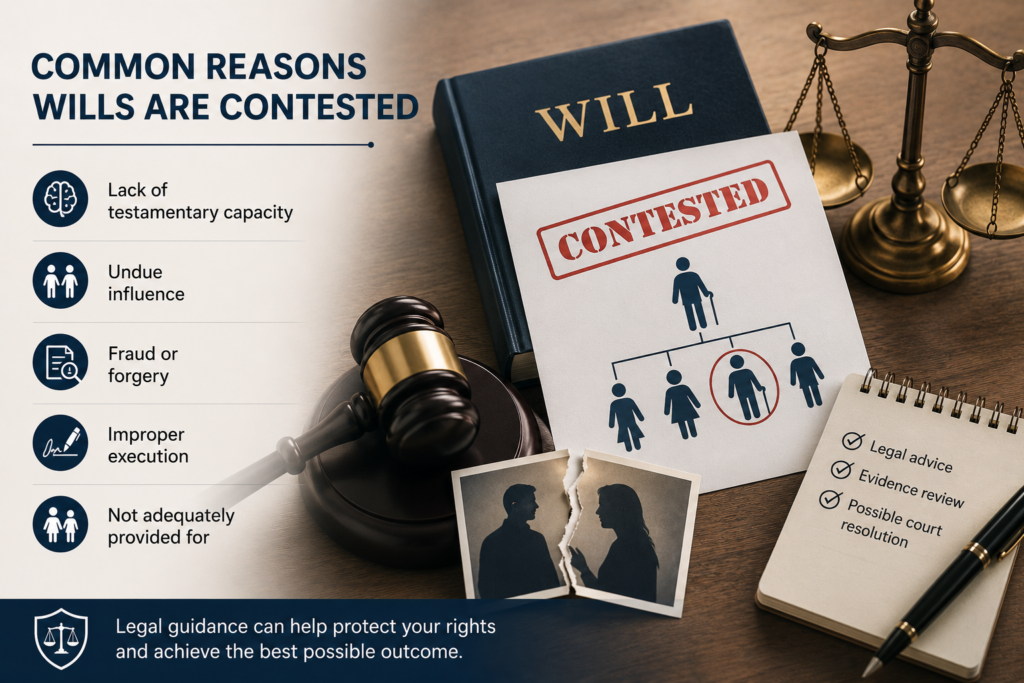
There are several legal reasons why a will may be challenged.

Lack of Testamentary Capacity

A person creating a will must understand the nature and effect of the document they are signing.

A challenge may arise if it is believed that the individual lacked the necessary mental capacity due to:

  • Dementia
  • Serious illness
  • Cognitive impairment
  • Other conditions affecting decision-making abilities

If the person did not fully understand their actions at the time the will was made, the document may be declared invalid.


Undue Influence

Undue influence occurs when someone exerts pressure, coercion, or manipulation over the person making the will.

This may result in provisions that do not genuinely reflect the individual’s wishes.

Where evidence of undue influence exists, the court may set aside the will or relevant parts of it.


Fraud or Forgery

A will may also be challenged if there is evidence that it was created dishonestly.

Examples include:

  • Forged signatures
  • Altered documents
  • False information used to create the will
  • Deliberate deception during the preparation process

Fraud and forgery are serious allegations that can lead to the will being declared invalid.


Improper Execution

For a will to be legally valid, it must comply with specific legal requirements.

These requirements generally include:

  • Proper signing of the document
  • Correct witnessing procedures
  • Compliance with applicable legal formalities

If these rules are not followed, the validity of the will may be challenged.


Inadequate Financial Provision

Certain individuals may have the right to bring a claim if they believe the will does not make reasonable financial provision for them.

This commonly applies to:

  • Spouses and civil partners
  • Children
  • Former spouses in certain circumstances
  • Financial dependants

The court may review the circumstances and determine whether additional provision should be made from the estate.


The Process of Contesting a Will

The first step is usually to seek professional legal advice.

A solicitor can assess the facts of the case, review available evidence, and determine whether there are valid grounds for a challenge.

In many situations, disputes can be resolved through negotiation or mediation without the need for court proceedings.

However, if an agreement cannot be reached, the matter may proceed to court, where a judge will consider the evidence and decide whether the will should be upheld, amended, or declared invalid.


The Importance of Legal Advice

Will disputes can be legally complex and emotionally challenging for everyone involved.

Obtaining expert legal guidance at an early stage can help protect your interests, clarify your options, and ensure that any claim is handled effectively.

Professional support can also increase the likelihood of achieving a fair and practical resolution while minimising unnecessary conflict between family members and beneficiaries.

Can a Will Be Contested? Grounds and Legal Process Read More »

What Happens If You Die Without a Will (Intestacy Explained)

What Happens If You Die Without a Will?

When a person dies without leaving a valid Will, they are considered to have died intestate. In these circumstances, the distribution of their estate is determined by intestacy laws rather than by their personal wishes.

The rules of intestacy set out a strict order of inheritance, which may not reflect how the deceased intended their assets to be distributed.


Understanding Intestacy Rules

Intestacy laws determine who is entitled to inherit from an estate when no valid Will exists.

The estate is distributed according to a legal hierarchy of relatives, regardless of personal relationships or verbal wishes expressed during the deceased’s lifetime.


If You Have a Spouse or Civil Partner

Where the deceased was married or in a civil partnership, the surviving spouse or partner will usually inherit a substantial portion of the estate.

However, if there are children, the estate may be divided between the surviving spouse and the children according to the applicable legal rules.

The exact distribution will depend on the value of the estate and the family circumstances.


What About Unmarried Partners?

One of the most common misconceptions is that long-term unmarried partners automatically inherit from each other.

In reality, unmarried partners do not generally have an automatic right to inherit under intestacy rules, regardless of how long they have lived together.

This can leave a surviving partner in a difficult financial position and may require separate legal action to seek provision from the estate.


Inheritance Rights of Children

If the deceased leaves children but no surviving spouse or civil partner, the estate will usually be divided equally among the children.

If a child has already passed away, their share may pass to their own children, ensuring that future generations of the family can still benefit from the inheritance.


Other Family Members

Where there is no spouse, civil partner, or children, the estate may pass to other relatives in a legally prescribed order, including:

  • Parents
  • Brothers and sisters
  • Nieces and nephews
  • Grandparents
  • Aunts and uncles
  • More distant relatives

The law determines who inherits based on family relationships rather than personal preference.


What Happens If No Relatives Can Be Found?

In rare circumstances where no eligible relatives can be identified, the estate may pass to the government as ownerless property.

This means that none of the deceased’s friends, charities, or other preferred beneficiaries will receive any inheritance unless they are specifically named in a valid Will.


Estate Administration Without a Will

When there is no Will, there is no appointed executor to manage the estate.

Instead, the court appoints an administrator who takes responsibility for:

  • Collecting assets
  • Paying debts and liabilities
  • Managing estate administration
  • Distributing inheritance to beneficiaries

Although the role is similar to that of an executor, the administrator is selected according to legal rules rather than by the deceased.


Potential Complications of Intestacy

Dying without a Will can create a number of challenges, including:

  • Delays in administering the estate
  • Increased legal and administrative costs
  • Uncertainty regarding inheritance rights
  • Financial difficulties for loved ones
  • Greater potential for family disputes

Without clear written instructions, disagreements can arise over how assets should be distributed.


Why Making a Will Matters

Creating a valid Will gives you control over what happens to your estate after your death.

A Will allows you to:

  • Choose who will inherit your assets
  • Appoint trusted executors
  • Provide for loved ones and dependants
  • Leave gifts to friends or charities
  • Nominate guardians for minor children

Most importantly, a Will ensures that your wishes are clearly documented and legally recognised.


Planning for the Future

Making a Will is one of the most effective steps you can take to protect your family and provide certainty for the future.

By planning ahead, you can reduce the risk of disputes, simplify the administration process, and ensure that your estate is distributed according to your wishes rather than the default rules of intestacy.

What Happens If You Die Without a Will (Intestacy Explained) Read More »

Common Mistakes to Avoid When Making a Will

Common Mistakes to Avoid When Making a Will

Creating a Will is one of the most important aspects of estate planning. A well-prepared Will ensures that your assets are distributed according to your wishes and helps reduce the burden on your loved ones after your death.

However, many people make avoidable mistakes that can lead to legal complications, family disputes, and delays in administering an estate.


Failing to Make a Will

One of the most significant mistakes is not creating a Will at all.

If you die without a valid Will, your estate will be distributed according to intestacy laws. This means the law determines who inherits your assets, regardless of your personal wishes.

As a result, family members or loved ones you intended to benefit may receive little or nothing from your estate.


Not Updating Your Will

A Will should be reviewed regularly to ensure it reflects your current circumstances.

Major life events that may require updates include:

  • Marriage or civil partnership
  • Divorce or separation
  • The birth or adoption of children
  • Purchasing property
  • Significant changes in financial circumstances

Failing to update your Will can result in outdated instructions that no longer reflect your intentions.


Choosing the Wrong Executor

Your executor is responsible for administering your estate and ensuring your wishes are carried out correctly.

Choosing someone who is:

  • Unreliable
  • Unwilling to act
  • Lacking organisational skills
  • Unable to manage complex responsibilities

can lead to delays, administrative problems, and potential disputes among beneficiaries.

Selecting a trustworthy and capable executor is essential.


Using Unclear Language

Ambiguous or vague wording can create uncertainty about your intentions.

For example, failing to clearly identify:

  • Beneficiaries
  • Specific gifts
  • Property or assets

may lead to disagreements over who should inherit certain items.

Clear and precise language helps minimise the risk of future disputes.


Improper Signing and Witnessing

A Will must comply with strict legal requirements to be valid.

If it is not properly:

  • Signed
  • Witnessed
  • Executed according to legal formalities

the document may be challenged or declared invalid.

Even minor errors during the signing process can have serious consequences.


Forgetting Certain Assets

Many people focus on major assets while overlooking other valuable possessions.

When preparing a Will, consider all aspects of your estate, including:

  • Property and land
  • Bank accounts
  • Investments
  • Business interests
  • Personal belongings
  • Digital assets

Failing to account for certain assets can create confusion and complicate estate administration.


Ignoring Inheritance Tax Planning

Some individuals do not consider the potential inheritance tax implications of their estate.

Proper estate planning may help:

  • Reduce tax liabilities
  • Preserve more wealth for beneficiaries
  • Improve the overall efficiency of estate distribution

Professional advice can help identify available planning opportunities.


Storing Your Will Incorrectly

A professionally drafted Will is of little use if it cannot be located when needed.

Common problems include:

  • Losing the original document
  • Storing it in an inaccessible location
  • Failing to inform family members where it is kept

Keeping your Will in a secure yet accessible place can prevent unnecessary delays and legal difficulties after your death.


Attempting Complex Planning Without Professional Advice

While simple Wills may appear straightforward, estate planning can become complicated when significant assets, businesses, blended families, or tax considerations are involved.

Attempting to prepare a complex Will without professional guidance can increase the risk of mistakes that may later result in disputes or legal challenges.

A solicitor can help ensure that your Will is properly drafted, legally valid, and tailored to your individual circumstances.


Protecting Your Family and Your Wishes

A carefully prepared Will provides clarity, certainty, and peace of mind for both you and your loved ones.

By avoiding common mistakes and seeking professional advice where necessary, you can help ensure that your estate is administered smoothly and that your wishes are carried out exactly as intended.

Common Mistakes to Avoid When Making a Will Read More »

How to Choose the Right Lasting Power of Attorney

How to Choose the Right Attorney for a Lasting Power of Attorney (LPA)

A Lasting Power of Attorney (LPA) is one of the most important legal documents you can put in place for the future. It allows a trusted individual to make decisions on your behalf if you become unable to manage your own affairs.

Because an attorney may be responsible for significant decisions relating to your health, welfare, finances, or property, choosing the right person is a decision that should be made carefully.

Why Choosing the Right Attorney Matters

Your attorney will have a legal duty to act in your best interests and make decisions that reflect your wishes and values.

The person you appoint may be responsible for managing sensitive matters, including:

  • Financial accounts and investments
  • Property and assets
  • Healthcare decisions
  • Daily care arrangements
  • Communication with professionals and family members

For this reason, selecting someone you trust completely is essential.

Trust Is the Most Important Factor

An attorney should be someone who is honest, dependable, and capable of acting responsibly on your behalf.

Many people choose:

  • A spouse or partner
  • An adult child
  • A sibling
  • A close friend
  • A professional adviser

Whoever you choose should be someone you believe will always act in your best interests and respect your wishes.

Consider Reliability and Responsibility

Being an attorney involves more than simply making decisions when needed.

The role may require someone to:

  • Manage finances
  • Pay bills and expenses
  • Handle legal documents
  • Make important healthcare decisions
  • Deal with property matters

An organised and responsible individual is often best suited to these duties.

The Importance of Good Communication Skills

Attorneys frequently need to communicate with a range of people, including:

  • Medical professionals
  • Care providers
  • Banks and financial institutions
  • Solicitors and legal professionals
  • Family members

Choosing someone who can communicate clearly and confidently can help ensure matters are handled efficiently and effectively.

Appointing More Than One Attorney

Many people choose to appoint multiple attorneys.

This can provide several advantages, including:

  • Shared responsibility
  • Additional oversight
  • Greater flexibility in decision-making

However, it is important to select individuals who can work together cooperatively and make decisions in a constructive manner.

Disagreements between attorneys can create unnecessary delays and complications.

Make Sure They Are Willing to Act

Before appointing someone as your attorney, it is important to discuss the role with them.

Acting as an attorney can involve:

  • Significant responsibility
  • Time commitments
  • Complex decision-making
  • Ongoing administrative duties

Ensuring they fully understand and accept these responsibilities can help prevent problems later.

Think About Age and Future Availability

While trust and capability are crucial, it is also sensible to consider whether your chosen attorney is likely to be available when needed.

Factors to think about include:

  • Their age
  • Health
  • Location
  • Long-term availability

Someone considerably older than you may not be the most practical long-term choice, particularly if the LPA is not needed for many years.

Registering the LPA

Once you have selected your attorney, the Lasting Power of Attorney must be properly prepared and registered before it can be used.

Registration ensures that the document is legally recognised and allows your attorney to act when necessary.

Completing the process correctly is an important step in protecting your future interests.

Planning Ahead with Confidence

Creating a Lasting Power of Attorney provides reassurance that important decisions will be handled by someone you trust if you are ever unable to make those decisions yourself.

By carefully selecting the right attorney and putting the appropriate arrangements in place, you can help safeguard your wellbeing, protect your assets, and provide peace of mind for both yourself and your loved ones.

How to Choose the Right Lasting Power of Attorney Read More »

What Is Probate and When Is It Needed?

What Is Probate? A Guide to the Probate Process

Probate is the legal process of administering a person’s estate after they have passed away. It provides the legal authority required to manage the deceased person’s assets, settle outstanding debts, and distribute the estate to beneficiaries.

Understanding how probate works can help families, executors, and beneficiaries navigate the process more effectively during what is often a difficult time.


What Is Probate?

Probate is the court-approved process that confirms an individual’s authority to deal with a deceased person’s estate.

The estate may include:

  • Property and land
  • Bank and savings accounts
  • Investments and shares
  • Vehicles
  • Personal possessions
  • Other financial assets

The purpose of probate is to ensure that the estate is administered lawfully and that the deceased person’s wishes are carried out correctly.


Who Applies for Probate?

If the deceased left a valid Will, the person appointed as executor is usually responsible for applying for probate.

The executor’s role includes:

  • Identifying assets and liabilities
  • Managing the estate
  • Paying outstanding debts
  • Distributing assets to beneficiaries

If there is no valid Will, a close family member may apply for authority to administer the estate instead. In these cases, the person appointed is known as an administrator rather than an executor.


The Probate Process Explained

1. Valuing the Estate

The first step is to establish the total value of the estate.

This involves identifying and assessing all assets, including:

  • Property
  • Bank accounts
  • Investments
  • Valuable personal belongings

The executor must also identify any outstanding debts and liabilities.

Accurate valuation is essential, particularly when determining whether inheritance tax is payable.


2. Applying for Probate

Once the estate has been valued, an application is submitted to the relevant court.

The application includes information about:

  • The deceased person
  • The executor or administrator
  • The value of the estate
  • Any inheritance tax obligations

If the application is approved, the court issues legal authority to administer the estate.


3. Obtaining the Grant of Probate

When a valid Will exists, the court issues a document known as a Grant of Probate.

This document confirms the executor’s authority to act on behalf of the estate.

The Grant of Probate allows the executor to:

  • Access financial accounts
  • Sell or transfer property
  • Collect funds owed to the estate
  • Manage investments
  • Distribute assets to beneficiaries

Without this authority, many organisations will not release funds or transfer assets.


4. Administering the Estate

Once probate has been granted, the executor can begin managing the estate.

This typically includes:

  • Collecting assets
  • Paying outstanding debts
  • Settling taxes
  • Closing accounts
  • Distributing inheritances according to the Will

The executor must keep accurate records and ensure all legal obligations are met throughout the process.


Is Probate Always Necessary?

Probate is not required in every estate.

In some situations, assets may pass automatically to another person without the need for probate.

Examples include:

  • Jointly owned property
  • Joint bank accounts
  • Certain pension or insurance benefits

Small estates may also qualify for simplified procedures depending on the circumstances.

However, many banks and financial institutions require probate before releasing funds held solely in the deceased person’s name.


How Long Does Probate Take?

The time required to complete probate varies depending on the size and complexity of the estate.

Factors that may affect the timeline include:

  • Property sales
  • Multiple assets
  • Tax matters
  • Missing documents
  • Beneficiary disputes

Straightforward estates may be resolved within a few months, while more complex estates can take considerably longer.


Common Challenges During Probate

Executors often face a variety of responsibilities and legal requirements.

Common challenges include:

  • Locating all assets
  • Dealing with inheritance tax obligations
  • Managing property sales
  • Resolving family disagreements
  • Completing legal paperwork accurately

Errors during probate can result in delays, additional costs, or legal complications.


Why Professional Advice Can Help

Many executors choose to seek assistance from a solicitor when administering an estate.

Professional legal guidance can help with:

  • Probate applications
  • Estate valuation
  • Tax matters
  • Asset distribution
  • Resolving disputes

Expert support can reduce stress and help ensure that the estate is administered correctly and efficiently.


Planning Ahead for the Future

Understanding probate is an important part of estate planning. A properly prepared Will, accurate record-keeping, and professional advice can make the probate process significantly smoother for loved ones after your death.

By planning ahead, you can help ensure that your estate is managed efficiently, your wishes are respected, and your beneficiaries receive their inheritance with minimal delays or complications.

What Is Probate and When Is It Needed? Read More »

The Role of an Executor in Your Will

The Role of an Executor: Responsibilities and Duties Explained

An executor plays a vital role in administering a person’s estate after their death. When creating a Will, an individual appoints an executor to ensure their final wishes are carried out and their estate is managed according to the law.

The role involves a range of legal, financial, and administrative responsibilities, making the choice of executor one of the most important decisions when preparing a Will.


What Is an Executor?

An executor is the person or organisation named in a Will to manage the deceased person’s estate after their death.

Their primary responsibility is to ensure that the instructions contained within the Will are followed correctly and that the estate is distributed to the intended beneficiaries.

The individual who creates the Will is known as the testator, and it is their responsibility to appoint a suitable executor.


Locating and Reviewing the Will

One of the executor’s first responsibilities is to locate the original Will and verify that it is the most recent valid version.

The Will provides essential guidance regarding:

  • Beneficiaries
  • Asset distribution
  • Specific gifts
  • Funeral wishes (if included)
  • Any other instructions left by the deceased

Understanding the contents of the Will is the foundation of effective estate administration.


Identifying and Valuing Estate Assets

The executor must identify all assets belonging to the estate and determine their value.

These assets may include:

  • Property and land
  • Bank and savings accounts
  • Investments and shares
  • Business interests
  • Vehicles
  • Jewellery and personal possessions
  • Other valuable items

Accurately valuing the estate is an important step in both probate and tax calculations.


Paying Debts and Liabilities

Before beneficiaries can receive their inheritance, the executor must settle any outstanding financial obligations.

This may include:

  • Funeral expenses
  • Outstanding loans
  • Credit card balances
  • Utility bills
  • Taxes owed by the estate

Ensuring all debts are properly paid protects both the estate and its beneficiaries from future complications.


Applying for Probate

In many estates, the executor will need to apply for probate.

Probate is the legal process that confirms the executor’s authority to administer the estate.

Once the court issues a Grant of Probate, the executor gains the legal authority to:

  • Access financial accounts
  • Collect assets
  • Sell property where necessary
  • Deal with financial institutions
  • Distribute inheritance to beneficiaries

Without probate, many organisations will not release assets held solely in the deceased person’s name.


Distributing Assets to Beneficiaries

After debts, taxes, and expenses have been settled, the executor can distribute the remaining estate according to the instructions in the Will.

This may involve:

  • Transferring property ownership
  • Distributing financial assets
  • Delivering specific gifts
  • Dividing estate funds among beneficiaries

The executor must ensure that distributions are carried out fairly and in accordance with the deceased person’s wishes.


Communicating with Beneficiaries

Good communication is an important aspect of estate administration.

Executors should keep beneficiaries informed about:

  • The progress of probate
  • Significant developments
  • Expected timelines
  • Any delays or complications

Open communication helps reduce misunderstandings and can minimise the risk of disputes.


Choosing the Right Executor

Because the role carries significant responsibility, selecting the right executor is essential.

An ideal executor should be:

  • Trustworthy
  • Organised
  • Financially responsible
  • Capable of handling administrative tasks
  • Able to communicate effectively

Many people appoint:

  • A spouse or partner
  • An adult child
  • A trusted friend
  • A professional such as a solicitor

The choice should be based on the individual’s ability to manage the responsibilities involved.


Appointing Multiple Executors

It is possible to appoint more than one executor.

This can offer several advantages, including:

  • Shared responsibility
  • Additional oversight
  • Greater flexibility in estate administration

However, it is important that all executors can work together effectively, as disagreements may cause delays and complications.


Seeking Professional Support

Administering an estate can be complex, particularly where there are significant assets, property holdings, tax issues, or family disputes.

Executors often seek assistance from:

  • Solicitors
  • Probate specialists
  • Financial advisers
  • Tax professionals

Professional guidance can help ensure that legal requirements are met and that the estate is administered correctly and efficiently.


Ensuring a Smooth Estate Administration

The executor’s role is essential in protecting the interests of beneficiaries and ensuring the deceased person’s wishes are respected.

By carrying out their duties carefully and following the appropriate legal procedures, executors help ensure that estates are administered fairly, efficiently, and in accordance with the law.

Choosing a capable executor today can make a significant difference to how smoothly an estate is managed in the future.

The Role of an Executor in Your Will Read More »

your Will

Why your children may not inherit what it says in your Will!

What goes hand in hand with your financial advice that your client will be indebted to you for arranging for them?

Estate Planning! – Your clients will forever be grateful that not only have you sorted out their long term financial plan but you also helped them ensure that their assets are protected when the they pass from this world.

There are so many different facets to Estate Planning that clients just have not thought about.

Why would your clients want to invest and save all their lives (with your help) and then have 40% of it to go into inheritance tax and the rest of it divided amongst people they didn’t intend to.

Let me tell you of a horror story. Mr. Thrifty married to Mrs. Thrifty hopes that one day his only child, Lucy will inherit his £1m home. You have advised them to get a mirror Will that they obtained from the Internet.

However, Mr. Thrifty dies a year later in an accident. The home transfers to Mrs. Thrifty who marries her tennis coach, Mr. Opportunity a year later. They have two children. She makes a new will, leaving everything to her children.

Unfortunately they divorce ten years later, and Mr. Opportunity receives half the value of the house (£500,000) in the divorce settlement. Mrs. Thrifty dies in shock and the rest of the estate is divided amongst the three children. Lucy receives £166,000.

This is not what Mr. Thrifty had intended when he was setting out his long-term financial plan with you.

And the moral of this story is…

If there is a lesson to be learned from the above tale, it is this:

  • It is a good investment to obtain sound Estate Planning advice.

Please contact me on [email protected] or 0207 041 6069 to find out how I can best help you protect your family and your assets.

Why your children may not inherit what it says in your Will! Read More »

jointly-owned property

What happens to jointly-owned property when someone dies without a Will?

What Happens to Property and Personal Possessions If You Die Without a Will?

Many people assume that their spouse, partner, or loved ones will automatically inherit their assets when they pass away. However, when someone dies without a valid Will, the outcome largely depends on how their assets are owned and the rules of intestacy.

Understanding these rules is essential to ensure your family and assets are protected.


Ownership of Property Matters

The way a property is owned and registered can have a significant impact on what happens after death.

Beneficial Joint Tenants

Married couples and civil partners commonly own property as beneficial joint tenants.

Under this arrangement, when one owner dies, their share automatically passes to the surviving owner.

This transfer occurs outside of the intestacy rules and does not require the deceased’s share to be distributed through their estate.

The same principle generally applies to unmarried couples who own property as beneficial joint tenants.

However, where the value of the deceased’s share exceeds available inheritance tax allowances, inheritance tax may still need to be considered.


Tenants in Common

Many unmarried couples choose to own property as tenants in common.

This arrangement allows:

  • Different ownership percentages
  • Greater flexibility in estate planning
  • Each owner to leave their share to whomever they choose through a Will

While this can be beneficial, it also creates risks when no Will exists.

If one owner dies intestate, their share of the property does not automatically pass to the surviving co-owner. Instead, it is distributed according to the intestacy rules.

This can lead to unexpected outcomes and potential financial difficulties for the surviving owner.


What Are Chattels?

The term “chattels” refers to personal possessions that are used and enjoyed by an individual.

Examples include:

  • Furniture
  • Vehicles
  • Jewellery
  • Artwork
  • Household contents
  • Collectibles used for personal enjoyment

Items held purely as investments are generally treated differently and may not fall within the legal definition of personal chattels.


Who Inherits Personal Possessions?

Where the deceased was married or in a civil partnership and died without a Will, personal chattels will usually pass entirely to the surviving spouse or civil partner.

However, unmarried partners do not receive the same protection.

In those circumstances, personal possessions form part of the estate and are distributed according to the intestacy rules, regardless of the deceased’s intentions.


A Practical Example

Consider the following scenario:

Jack and Jill have been in a committed relationship for 20 years but have never married.

  • Jack has two children from a previous marriage.
  • Jill has no children, but her father is still living.
  • Together they purchase a property worth £1 million.
  • The property is registered as tenants in common with equal ownership shares.
  • Neither of them has made a Will.

If Jack Dies

Jack’s share of the property will pass to his two children under the intestacy rules.

His personal possessions, including his valuable wine collection, would also form part of his estate and pass according to those same rules.

Jill would not automatically inherit Jack’s share of the property.

If Jill Dies

Jill’s share of the property would pass to her father under the intestacy rules.

Her personal possessions, including her record collection, would also pass as part of her estate.

Again, Jack would not automatically inherit Jill’s share despite their long-term relationship.


The Risks of Dying Without a Will

As this example demonstrates, intestacy laws do not always reflect modern family arrangements or personal wishes.

Without a Will, there is a risk that:

  • Unmarried partners receive nothing
  • Family disputes arise
  • Property ownership becomes complicated
  • Assets pass to unintended beneficiaries
  • Estate administration becomes more complex

Why Estate Planning Is Essential

A properly drafted Will allows you to:

  • Decide who inherits your assets
  • Protect unmarried partners
  • Control how property is distributed
  • Provide for children and dependants
  • Minimise the risk of disputes
  • Ensure your wishes are legally recognised

Estate planning is not only about protecting wealth—it is about providing certainty and security for the people who matter most.


Planning Ahead Protects Your Loved Ones

The lesson is simple: relying on intestacy rules can lead to unexpected and often undesirable outcomes.

Seeking professional estate planning advice and putting a valid Will in place can help ensure that your family, property, and personal possessions are protected exactly as you intend.

Taking action today can prevent significant legal and financial complications for your loved ones in the future.

What happens to jointly-owned property when someone dies without a Will? Read More »

DIY Will

8 reasons why a DIY Will is the cheapest option!

A quick Google search will provide you with many options for this and a ‘DIY’ or “home-made or Online Wills” Will can seem like a simple and inexpensive solution. After all, you can purchase a DIY Will kit for as little as a £20 from WHSmith!

The pitfalls for a DIY Will are:-

1.  Wills not witnessed correctly – this renders a Will completely invalid and your wishes won’t be carried out. You will be deemed to have died without a Will.  I have seen, where the ‘wrong’ people witness a Will, making the intentions of the Will void.

2.  The Will not actually covering all the assets in the estate – this creates a problem because the parts of the estate not covered pass as though you didn’t have a Will and could pass to someone you didn’t intend it to.

3.  Assets being incorrectly described, such as “my Prudential Insurance Policy”, when in fact the policy was an “assurance” policy or “my Midland bank account” when The Midland Bank had long since become part of HSBC. Such gifts could fail and your intended beneficiary may not receive them. What if the bank you have your money in now, changes it’s name in twenty years time.

4.  No consideration of what happens if a beneficiary dies before you – Wording used such as “I give £2,000 to Jane William” could leave confusion. Was the intention Jane should receive £2,000 if she was alive at your death only or did you want the gift to pass to her family if she died before you?

5.  Later amendments written on top of the original Will – such amendments may not be valid.

6.  The consequences of nursing home care fees or inheritance tax not being considered – meaning your estate could be eroded to pay for care or a larger inheritance tax bill might be payable by your family.

7.  Considering who is to look after your young children if you were to die – this is a complicated area, who are you going to appoint as a guardian, what will there legal duties or what consideration will you give if they can no longer care for your children. What are the legal consequences for when your children can inherit your estate.

8.  Ring fencing your estate so your children are guaranteed to inherit instead of it being diluted by your spouse’s new partner or your spouse’s future children – did you know most people leave their estate to their spouse with the intention of it being inherited by their children. What if your spouse was to get married again and leaves everything to his/her new spouse. What if your spouse has more children? Your estate will be diluted and your children receive a fraction of what your estate.

Please contact me on [email protected] or 0207 041 6069 to find out how I can best help you protect your family and your assets.

8 reasons why a DIY Will is the cheapest option! Read More »