
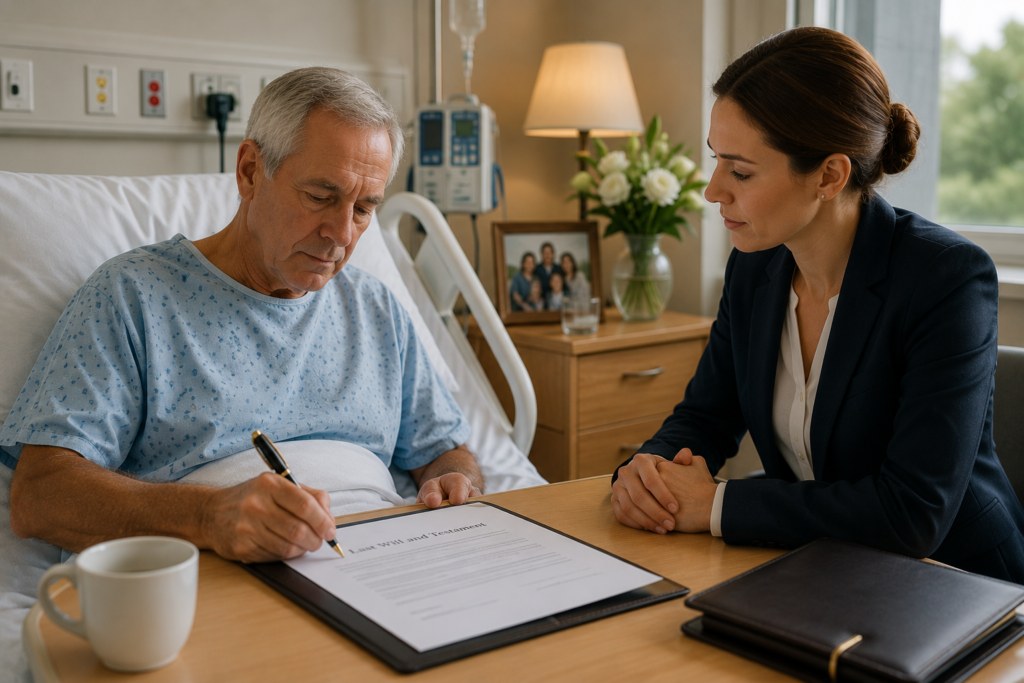
Serious illness can cause people to think about matters they may previously have postponed, including what should happen to their property, savings and possessions after death.
For some people, that conversation begins while they are receiving treatment in hospital.
This can create an understandable sense of urgency. A patient may realise that they have never made a will, that an existing will no longer reflects their circumstances, or that important changes are needed following marriage, separation, changes within the family or changes to their assets.
Being ill or admitted to hospital does not automatically prevent somebody from making or changing a will.
However, additional care may be required.
A valid will must satisfy legal requirements, and questions surrounding mental capacity, undue influence, voluntariness and proper witnessing can become particularly important when a person is seriously unwell.
Where time is limited, obtaining legal advice promptly can help ensure that the person’s wishes are properly understood and that the will is prepared and executed correctly.
This article explains some of the important considerations when making a will during illness or hospitalisation in England and Wales.
Can You Make a Will While in Hospital?
Yes.
There is no general rule preventing somebody from making a will simply because they are in hospital.
A person may be receiving treatment, recovering from an operation or living with a serious illness and still be capable of making a valid will.
The important questions concern whether the legal requirements for a valid will are satisfied.
Generally, the person must:
- Be aged 18 or over;
- Make the will voluntarily;
- Have the necessary mental capacity;
- Put the will in writing;
- Sign it using the legally required procedure; and
- Have the signature properly witnessed by two adults.
Hospitalisation itself does not remove a person’s ability to satisfy these requirements.
Why Might Someone Need a Will Urgently?
There are many reasons somebody may decide to make or update a will during illness.
They may never previously have made one.
Alternatively, an existing will may have been prepared many years earlier and no longer reflect their current circumstances.
For example, there may have been changes involving:
- Marriage or civil partnership;
- Separation or divorce;
- Children or grandchildren;
- Property ownership;
- Business interests;
- Financial circumstances;
- Intended beneficiaries;
- Executors; or
- Particular gifts.
A serious diagnosis can also prompt somebody to review arrangements that they had always intended to address “later”.
Where the person’s health is deteriorating, time can become important.
However, urgency should not mean that the legal safeguards surrounding wills are ignored.
What Happens If Someone Dies Without a Will?
A person who dies without leaving a valid will dies intestate.
Their estate is then distributed according to the intestacy rules.
Those rules determine which relatives are entitled to inherit and in what circumstances.
This may not produce the result the deceased person would have chosen.
For example, unmarried partners do not automatically have the same inheritance rights under intestacy as spouses or civil partners.
Making a will allows somebody to record their own wishes rather than relying on the statutory rules.
For somebody facing serious illness, that can provide important clarity for their family.
Does Serious Illness Mean Someone Lacks Mental Capacity?
No.
Physical illness and mental capacity are not the same thing.
A person can be seriously physically unwell while remaining entirely capable of understanding and making decisions.
Similarly, being elderly does not automatically mean that somebody lacks capacity.
The relevant issue is the person’s ability to make the particular decision at the relevant time.
Government guidance concerning mental capacity emphasises that capacity should not simply be assumed to be absent because somebody has an illness or disability.
A person should generally be presumed capable of making their own decisions unless the contrary is established.
What Is Mental Capacity?
Broadly, mental capacity concerns a person’s ability to make a particular decision.
Under the Mental Capacity Act framework, relevant considerations include whether somebody can understand information needed for a decision, retain it sufficiently to make that decision, weigh the relevant information and communicate their decision.
Capacity is also decision-specific and time-specific.
Someone might be able to make one decision but not another.
Likewise, a person’s capacity may fluctuate.
Illness, medication, pain, fatigue or confusion may potentially affect somebody differently at different times.
This can become particularly relevant in a hospital environment.
Is Capacity to Make a Will Different?
The capacity required to make a will is often referred to as testamentary capacity.
Will-making has its own established legal principles, and professional assessment may require careful consideration of whether the person understands the nature and effect of making a will, the broad extent of their estate and the people whose potential claims they ought to consider.
The fact that somebody needs assistance with other decisions does not necessarily mean they cannot make a will.
Indeed, government guidance concerning statutory wills expressly recognises that somebody who has lost capacity to manage their finances may still retain the ability to make their own will.
Capacity therefore needs to be considered specifically in relation to the will being made.
Why Can Capacity Become an Issue in Hospital?
Hospital patients may be experiencing circumstances that can affect decision-making temporarily or permanently.
For example, a person may be affected by:
- Serious illness;
- Cognitive impairment;
- Confusion;
- A brain injury;
- Effects of medical treatment;
- Fatigue; or
- Other factors affecting their ability to understand or communicate.
This does not mean that every hospital patient has questionable capacity.
It means that where there is a genuine concern, appropriate steps may need to be taken to assess and document the position.
In some circumstances, medical input may be appropriate.
Can a Solicitor Visit Someone in Hospital?
Depending on the firm and circumstances, solicitors may be able to arrange appointments away from their office, including hospital visits.
This can be particularly useful where somebody cannot travel because of their health.
Where the matter is urgent, the solicitor will normally need sufficient information to understand the person’s circumstances and wishes before the will can be prepared.
Practical arrangements may also need to be coordinated with the hospital, particularly where the patient is undergoing treatment or there are restrictions on visitors.
Contacting a solicitor as early as possible is therefore preferable to waiting until the situation becomes critical.
Why Might the Solicitor Want to Speak to the Patient Alone?
Family members often help an ill relative contact a solicitor.
There is nothing unusual about that.
However, the solicitor may need to speak privately with the person making the will.
This can be important for several reasons.
The solicitor needs to establish the client’s own instructions.
They may also need to consider whether the client understands what they are doing and whether their decisions are being made voluntarily.
If another person remains in the room answering questions or directing the conversation, it may become harder to establish that the will genuinely represents the client’s independent wishes.
A private conversation can therefore be an important safeguard.
What Is Undue Influence?
A will must reflect the testator’s own intentions.
Concerns can arise where another person pressures or coerces somebody into making a will or changing its contents.
This can become especially sensitive where a person is seriously ill or dependent on relatives or carers.
A family member may genuinely believe they are helping while inadvertently dominating discussions.
More serious cases may involve allegations that somebody deliberately pressured a vulnerable person for financial benefit.
A solicitor preparing a will should therefore obtain instructions from the client and be alert to circumstances that raise concerns about voluntariness or influence.
Can a Family Member Tell the Solicitor What the Will Should Say?
Family members can provide useful practical information, particularly where the client has mobility or communication difficulties.
But the will must ultimately reflect the wishes of the person making it.
A relative cannot simply instruct a solicitor to prepare somebody else’s will according to the relative’s preferences.
Where the client has capacity, the instructions must come from the client.
If the person no longer has the capacity required to make a will, a different legal process may need to be considered.
What If the Person Cannot Physically Sign?
Physical difficulty signing does not necessarily make it impossible to execute a will.
Current GOV.UK guidance confirms that someone can sign on the will-maker’s behalf where the will-maker is unable to sign personally, provided the required conditions are followed.
However, this is an area where professional assistance can be particularly valuable.
The execution must still comply with the legal formalities, and it should be clear that the signature is being made on the person’s behalf and at their direction.
Where health is poor, careful documentation can help reduce uncertainty later.
How Many Witnesses Are Required?
For an ordinary will in England and Wales, two adult witnesses are required.
The will-maker signs in the presence of both witnesses.
The witnesses then sign in the will-maker’s presence.
The required procedure must be followed correctly.
This can require some practical planning in a hospital, where access to the patient may be limited.
Suitable independent witnesses therefore need to be identified before execution.
Who Should Witness a Will?
Choosing witnesses carefully is important.
A beneficiary under the will should generally not act as a witness.
Nor should the spouse or civil partner of somebody receiving a gift under the will.
GOV.UK guidance warns that a person cannot leave their witnesses, or the witnesses’ married partners, anything under the will.
Using appropriate independent witnesses can help avoid problems.
In a hospital setting, the solicitor can advise on suitable arrangements rather than assuming that whoever happens to be present should witness the document.
Can Hospital Staff Witness a Will?
Whether an individual member of hospital staff can appropriately act as a witness will depend on the circumstances and relevant hospital policies.
There may be practical or professional restrictions.
It is therefore unwise to assume that doctors or nurses will automatically be available or willing to witness a will.
Where possible, witnessing arrangements should be discussed in advance.
A solicitor arranging an urgent hospital will can help identify what is required and coordinate an appropriate execution process.
What If the Patient Is Too Tired?
Capacity and ability to give instructions may vary during serious illness.
A person may be alert in the morning but exhausted after treatment.
Medication or medical procedures may also affect how well somebody can concentrate.
Where possible, a meeting should take place when the client is best able to engage with the process.
Government mental-capacity guidance recognises the importance of timing and circumstances when supporting people to make decisions.
A solicitor may therefore consider whether another time would allow the client to understand and communicate more effectively, provided the matter can safely wait.
What If Capacity Fluctuates?
Some medical conditions can cause capacity to fluctuate.
A person may be confused at one point but much clearer later.
The relevant question is whether they have the required capacity when the decision is being made.
This can make timing particularly important.
Where the circumstances allow, it may be appropriate to arrange discussions for a period when the person is more alert.
Where there is uncertainty, medical evidence may also be considered.
Can a Doctor Assess Capacity?
Medical professionals can provide valuable evidence where capacity is genuinely in question.
Government guidance recognises that doctors and other medical professionals may assist with capacity assessments.
For legal decisions such as making a will, the solicitor will need to be satisfied about the client’s ability to give valid instructions and make the will.
Where illness or cognitive difficulties create uncertainty, the solicitor may consider medical input appropriate.
The precise approach will depend on the circumstances.
Why Is Record-Keeping Important?
A will may not be examined closely until after the person who made it has died.
If somebody later challenges the will, questions might be raised about:
- The person’s capacity;
- Whether they understood the document;
- Whether they were pressured;
- Whether the will accurately recorded their instructions; or
- Whether it was executed correctly.
Where a will is prepared during serious illness, careful professional records can therefore be particularly important.
The solicitor may record the circumstances surrounding the instructions and execution and any steps taken to address capacity or undue-influence concerns.
What Information Does a Solicitor Need?
Even when a will is urgent, the solicitor needs enough information to understand what the client wants.
This may include details of:
- Family members;
- Intended beneficiaries;
- Property;
- Savings and investments;
- Business interests;
- Overseas assets;
- Existing wills;
- Executors;
- Specific gifts; and
- Any people the client wishes to provide for or intentionally exclude.
Complicated circumstances may require additional discussion.
Providing accurate information as early as possible can help when time is limited.
What If There Is Already a Will?
The solicitor should normally be told about any existing will.
The client may simply need to review whether it still reflects their wishes.
If substantial changes are required, making a new will may be appropriate.
Smaller changes can sometimes be made using a codicil, although the correct approach depends on the circumstances.
A new will can revoke an earlier one if properly drafted to do so.
Professional advice can help avoid creating conflicting documents or uncertainty about which version should apply.
Can a Will Be Changed at the Last Minute?
Potentially, yes, provided the person still has the required capacity and the legal formalities can be completed.
But last-minute changes can create additional risks.
There may be less time to obtain instructions, review complicated assets, consider tax consequences or investigate concerns about capacity.
Sudden substantial changes benefiting one family member while excluding others can also potentially lead to questions after death.
None of this means that a late will is automatically invalid.
It simply means that careful professional preparation can become particularly valuable.
What If the Person Is Very Close to Death?
Where somebody may have only a short time to live, the situation can become extremely urgent.
A solicitor should be contacted immediately.
The priority is to determine whether the person can still give valid instructions and whether there is enough time to prepare and properly execute the will.
Family members should avoid trying to answer questions on the person’s behalf where the individual can communicate their own wishes.
The fact that death is expected soon does not remove the requirements relating to capacity, voluntariness or execution.
What Happens If the Person No Longer Has Capacity?
If somebody no longer has the testamentary capacity required to make or change their own will, relatives cannot simply make one for them.
Instead, it may be possible to apply to the Court of Protection for a statutory will.
A statutory will is a will authorised by the Court of Protection on behalf of somebody who lacks the capacity to make one themselves.
The process requires evidence and court approval.
It is fundamentally different from an ordinary will made personally by someone with testamentary capacity.
What Is a Statutory Will?
A statutory will can be considered where a person cannot make or change a will themselves because they lack the necessary capacity.
The Court of Protection considers the application.
Government guidance indicates that the applicant must provide supporting information, including evidence concerning the person’s lack of capacity and details of the proposed will.
The Court determines whether the proposed arrangements should be authorised.
This is not simply a way for relatives to choose how another person’s estate should be distributed.
The court process exists to protect the interests of the person who lacks capacity.
Are Emergency Statutory Will Applications Possible?
Yes.
GOV.UK guidance specifically recognises that an emergency application can be made to the Court of Protection where the person concerned has only a short time to live.
However, court involvement is inevitably different from being able to make a personal will while capacity remains.
This is another reason early estate planning is preferable wherever possible.
Leaving matters until somebody is critically ill can significantly reduce the available options.
Should You Wait Until You Are Ill to Make a Will?
Ideally, no.
A hospital will can be valid and sometimes urgent circumstances cannot be avoided.
But making a will while healthy usually provides more time to think carefully about decisions, gather information and obtain advice.
There is also less risk that questions will arise about the effects of illness, medication, fatigue or cognitive impairment.
A will can be reviewed later if circumstances change.
Making one earlier therefore does not prevent future changes.
Will an Urgent Will Automatically Be Challenged?
No.
A will is not automatically invalid or suspicious merely because it was made shortly before death.
People are entitled to make or change wills while they have the necessary capacity and satisfy the legal requirements.
However, circumstances surrounding a late will can sometimes receive closer scrutiny, particularly if substantial changes were made or family members disagree about the person’s capacity or independence.
Following proper procedures and obtaining professional advice can help provide clearer evidence about how and why the will was made.
What Can Families Do to Help?
If a relative in hospital says they want to make a will, family members can help with practical arrangements without taking over the decision-making process.
They might:
- Help locate an existing will;
- Find contact details for a solicitor;
- Gather basic information about assets where requested;
- Help arrange an appointment;
- Inform hospital staff that a professional visitor may attend; and
- Give the client privacy to speak with the solicitor.
The goal should be to help the person express their own wishes.
Conclusion
Being seriously ill or admitted to hospital does not automatically prevent somebody from making a will.
What matters is whether the person has the required testamentary capacity, is acting voluntarily, can communicate their wishes and can complete the will using the legally required signing and witnessing procedure.
However, illness can make the process more complicated.
Capacity may fluctuate. Medication, treatment or fatigue may affect the person’s ability to engage at particular times. Family members may be heavily involved in their care, creating a need to ensure that instructions genuinely reflect the client’s own wishes. Practical arrangements must also be made for appropriate witnesses.
Where there is genuine doubt about capacity, medical input may be appropriate.
If the person cannot physically sign, alternative arrangements may still be possible provided the legal requirements are carefully followed.
Where somebody has already lost the capacity required to make their own will, relatives cannot simply create one for them. An application to the Court of Protection for a statutory will may instead need to be considered.
The most important practical lesson is not to delay.
Making or reviewing a will while healthy generally provides more time and fewer complications. But where illness has already occurred, obtaining specialist legal advice promptly can help establish what options remain available and ensure that the person’s wishes are handled with appropriate care.