
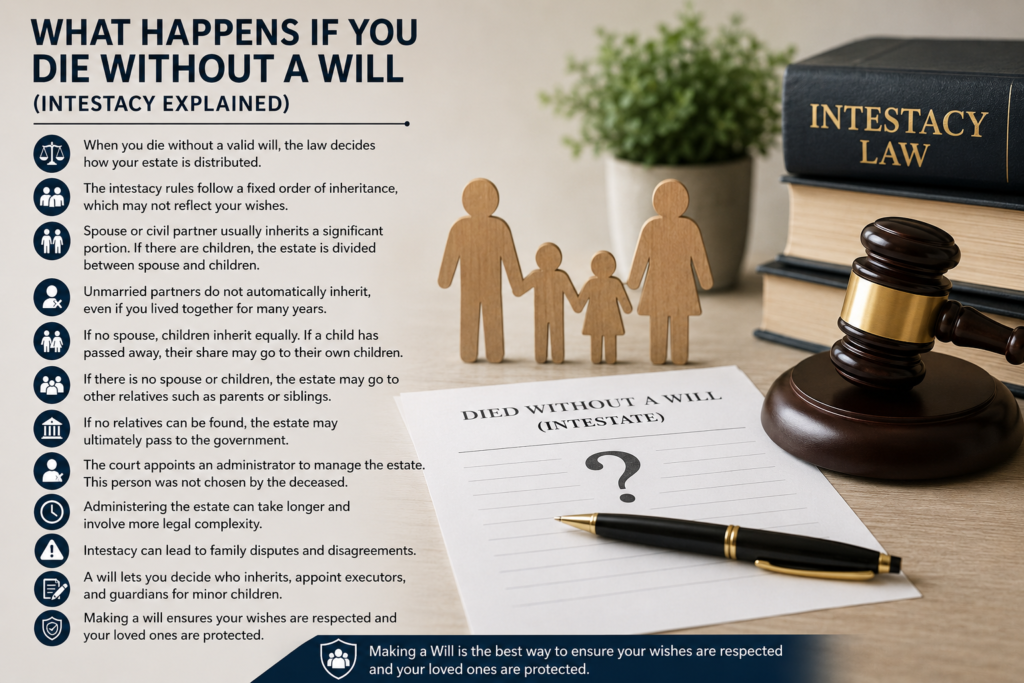
What Happens If You Die Without a Will?
When a person dies without leaving a valid Will, they are considered to have died intestate. In these circumstances, the distribution of their estate is determined by intestacy laws rather than by their personal wishes. The rules of intestacy set out a strict order of inheritance, which may not reflect how the deceased intended their assets to be distributed.
Understanding Intestacy Rules
Intestacy laws determine who is entitled to inherit from an estate when no valid Will exists. The estate is distributed according to a legal hierarchy of relatives, regardless of personal relationships or verbal wishes expressed during the deceased’s lifetime.
If You Have a Spouse or Civil Partner
Where the deceased was married or in a civil partnership, the surviving spouse or partner will usually inherit a substantial portion of the estate. However, if there are children, the estate may be divided between the surviving spouse and the children according to the applicable legal rules. The exact distribution will depend on the value of the estate and the family circumstances.
What About Unmarried Partners?
One of the most common misconceptions is that long-term unmarried partners automatically inherit from each other. In reality, unmarried partners do not generally have an automatic right to inherit under intestacy rules, regardless of how long they have lived together. This can leave a surviving partner in a difficult financial position and may require separate legal action to seek provision from the estate.
Inheritance Rights of Children
If the deceased leaves children but no surviving spouse or civil partner, the estate will usually be divided equally among the children. If a child has already passed away, their share may pass to their own children, ensuring that future generations of the family can still benefit from the inheritance.
Other Family Members
Where there is no spouse, civil partner, or children, the estate may pass to other relatives in a legally prescribed order, including:
- Parents
- Brothers and sisters
- Nieces and nephews
- Grandparents
- Aunts and uncles
- More distant relatives
The law determines who inherits based on family relationships rather than personal preference.
What Happens If No Relatives Can Be Found?
In rare circumstances where no eligible relatives can be identified, the estate may pass to the government as ownerless property. This means that none of the deceased’s friends, charities, or other preferred beneficiaries will receive any inheritance unless they are specifically named in a valid Will.
Estate Administration Without a Will
When there is no Will, there is no appointed executor to manage the estate.
Instead, the court appoints an administrator who takes responsibility for:
- Collecting assets
- Paying debts and liabilities
- Managing estate administration
- Distributing inheritance to beneficiaries
Although the role is similar to that of an executor, the administrator is selected according to legal rules rather than by the deceased.
Potential Complications of Intestacy
Dying without a Will can create a number of challenges, including:
- Delays in administering the estate
- Increased legal and administrative costs
- Uncertainty regarding inheritance rights
- Financial difficulties for loved ones
- Greater potential for family disputes
Without clear written instructions, disagreements can arise over how assets should be distributed.
Why Making a Will Matters
Creating a valid Will gives you control over what happens to your estate after your death.
A Will allows you to:
- Choose who will inherit your assets
- Appoint trusted executors
- Provide for loved ones and dependants
- Leave gifts to friends or charities
- Nominate guardians for minor children
Most importantly, a Will ensures that your wishes are clearly documented and legally recognised.
Planning for the Future
Making a Will is one of the most effective steps you can take to protect your family and provide certainty for the future. By planning ahead, you can reduce the risk of disputes, simplify the administration process, and ensure that your estate is distributed according to your wishes rather than the default rules of intestacy.